Leonardo da Vinci
1452–1519 · High Renaissance, Renaissance
Leonardo da Vinci (1452–1519) is one of the defining painters of the Renaissance and a central figure of the High Renaissance. His relatively small body of paintings changed how artists handled light, shadow and human expression. This gallery brings together his best-known works, with notes on what to look for in front of them.
 Annunciation1475–1485 · Uffizi Gallery
 Lady with an Erminec. 1490
 Saint John the Baptistc. 1514 · Louvre Museum
 Mona Lisa1503–1506 · Louvre Museum
 The Virgin and Child with Saint Annec. 1510 · Louvre Museum
 Ginevra de' Bencic. 1476–1478 · National Gallery of Art
 Benois Madonnac. 1479–1480
 Madonna Littac. 1481–1497
 Portrait of a Musicianc. 1485
 La Belle Ferronnièrec. 1496–1497 · Louvre Museum
 Salvator Mundic. 1504–1507
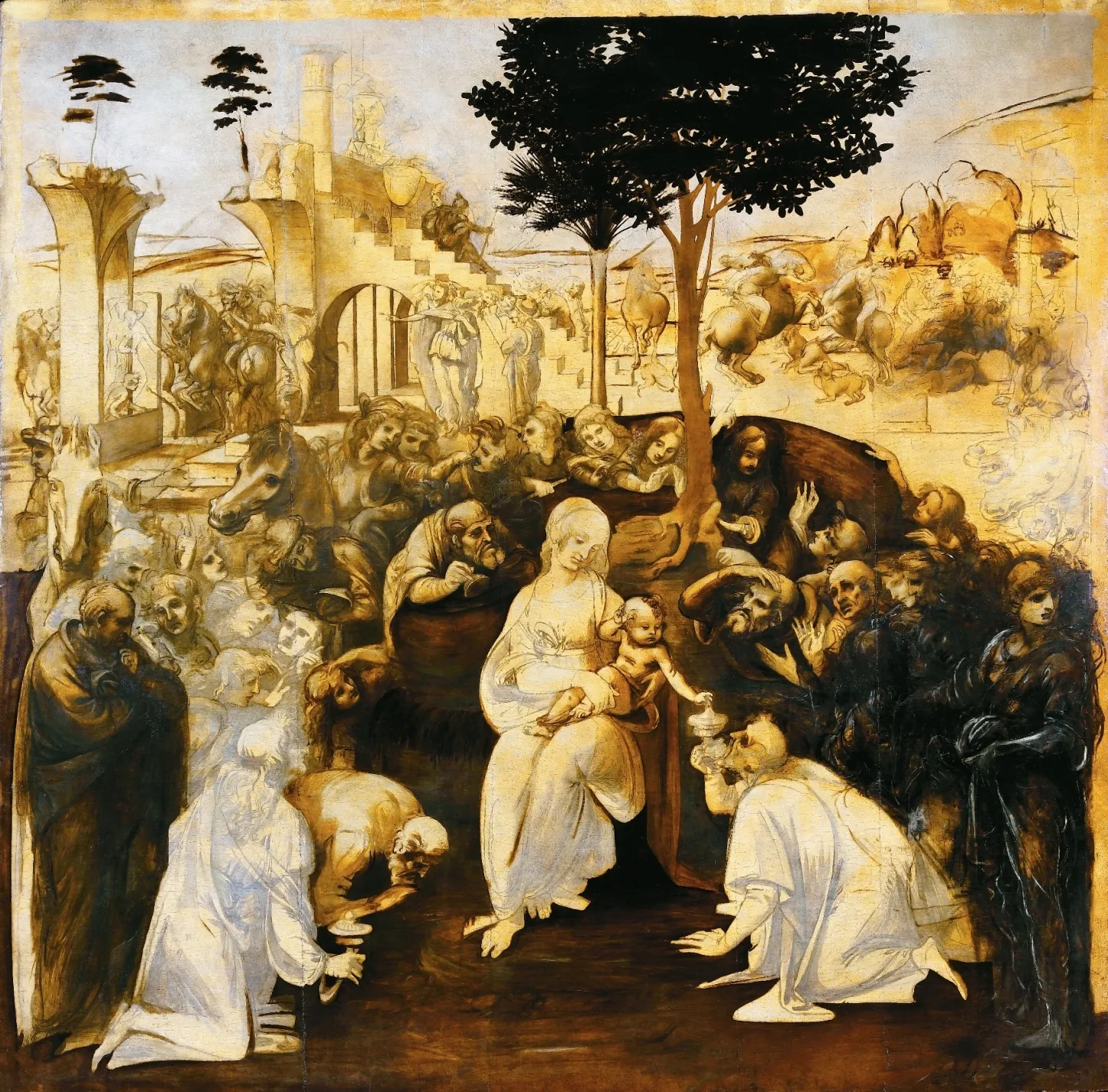 Adoration of the MagiUffizi Gallery
 Saint Jerome in the Wilderness
 Virgin of the Rocks1483–1486
 The Last Supper1498
 Madonna with the Yarnwinderc. 1501–1507
Life and work
Leonardo da Vinci was born in 1452 in Anchiano and died in 1519 at Clos Lucé. A painter of the Republic of Florence, he is one of the defining figures of the Renaissance, and especially of the High Renaissance, when artists sought a new balance of close observation, idealised form and unified composition. He trained in the workshop of Andrea del Verrocchio. His early pictures, such as the Annunciation and Ginevra de' Benci, already show careful study of light, plants and faces. Over his career he worked for a series of powerful patrons and moved between painting, engineering, anatomy and the study of nature, filling notebooks with drawings and observations. That breadth helps explain why his finished paintings are relatively few, and why several took years to complete, as the date ranges in this gallery suggest. His mature work, including The Last Supper, the Mona Lisa and The Virgin and Child with Saint Anne, is known for sfumato: the soft blending of tones without hard outlines. It is also known for figures bound together by gesture and glance rather than simply placed side by side. Later painters studied these innovations closely. His reputation as the model of the inquiring, endlessly curious artist has never faded.
Four paintings under one roof at the Louvre
The Louvre Museum holds four works from this gallery: the Mona Lisa, Saint John the Baptist, The Virgin and Child with Saint Anne and La Belle Ferronnière. Seeing them together lets you trace how Leonardo softened edges over time. In the Mona Lisa, look at the corners of the mouth and eyes, where shadows dissolve so gently that the expression seems to shift. Compare the hazy, bluish landscape behind her with the rocky setting of the Saint Anne. Then turn to Saint John, who emerges from a dark background with a raised hand and a direct gaze.
Early precision in the Annunciation and Ginevra de' Benci
For Leonardo's early style, see the Annunciation at the Uffizi Gallery and Ginevra de' Benci at the National Gallery of Art. In the Annunciation, look closely at the angel's wings, modelled on a real bird's, and at the carefully varied flowers in the meadow, signs of his habit of drawing from nature. In Ginevra de' Benci, the sitter's pale face is set against a dark, spiky juniper bush, widely read as a play on her name. Her features are shaped by subtle shading rather than strong lines, an early hint of the sfumato he later perfected.
Where to see the paintings
| Uffizi Gallery | |
|---|---|
| Louvre Museum | |
| National Gallery of Art |


Works may be off view or on loan. See each painting’s page for museum details.
Sources
- Wikidata Q762
- Images: Wikimedia Commons (public domain / CC0); sources on each painting’s page